
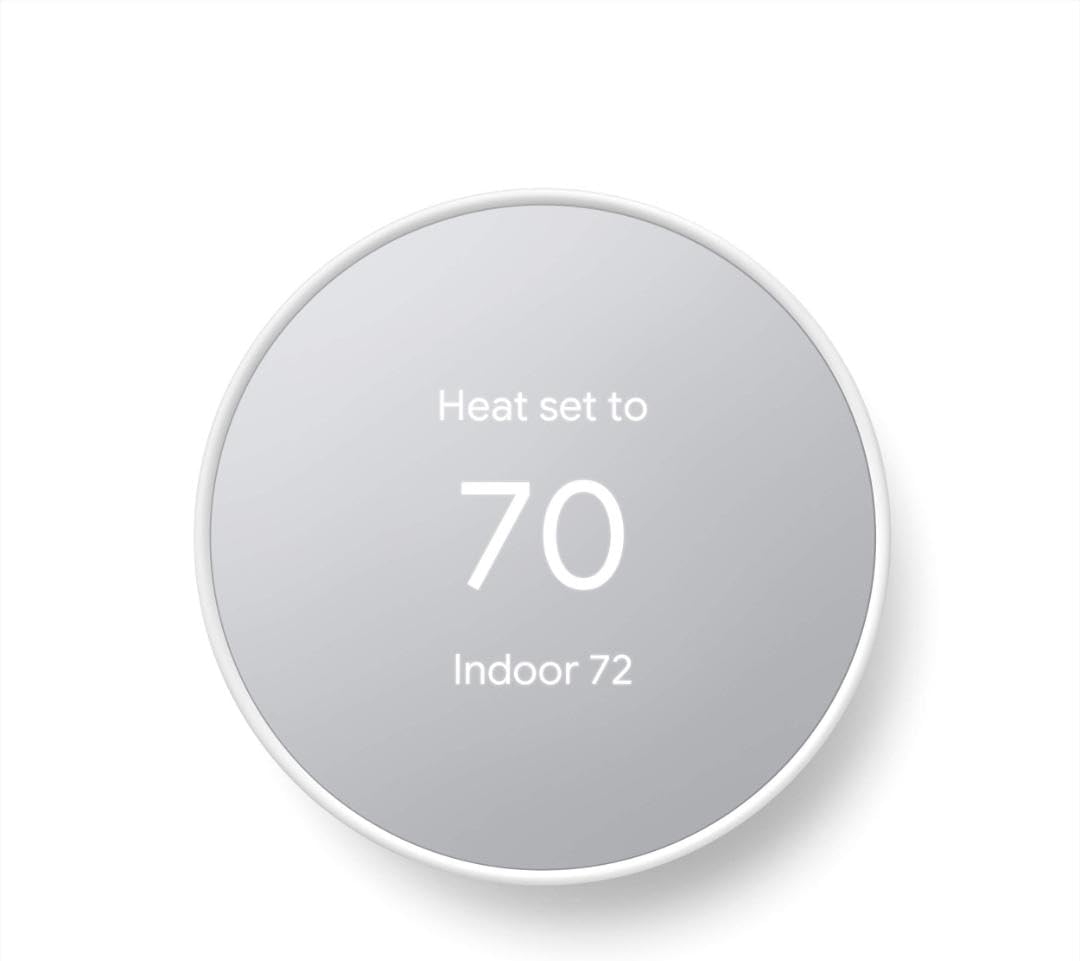


Google Nest Thermostat – Smart Thermostat for Home – Programmable Wifi Thermostat – Snow
Smart thermostats have become a common upgrade for homeowners looking to modernize their heating and cooling routines, and the Google Nest Thermostat in Snow is one of the more approachable options on the market. It sits in Google’s lineup as a straightforward, self-installable device that focuses on the essentials: remote control, scheduling, and energy awareness. This review takes a closer look at what this thermostat offers, how it fits into a smart home setup, and who might get the most use out of it.
Design & Build Quality
The Snow colorway gives the thermostat a clean, neutral look that tends to blend in with a variety of wall colors and interior styles. While the supplied information does not detail the exact materials or dimensions, the design language is consistent with Google’s modern smart home aesthetic—simple, minimal, and unobtrusive.
One of the key design considerations for any thermostat is whether it will work with your existing wiring. The Nest Thermostat is designed to work in most homes without a common wire, often referred to as a C wire. That said, there are exceptions. For systems that are heating-only, cooling-only, zone-controlled, or heat pump-based, a C wire or another compatible power accessory may be necessary. This is an important point to check before purchasing, and Google provides an online Nest Compatibility Checker on its support page to help you verify your system ahead of time. That tool can save you from the hassle of discovering an incompatibility after the unit arrives.
The thermostat also supports a wireless interconnect via Bluetooth Low Energy, which is worth noting if you are thinking about how the device communicates with other nearby equipment. The primary connection, however, is Wi-Fi, with support for 802.11b/g/n on 2.4 GHz and 802.11a/n on 5 GHz bands.
Features & Technology
The headline feature of the Nest Thermostat is its ability to turn itself down when you leave the house. The idea is straightforward: if no one is home, there is no reason to keep heating or cooling an empty space. The thermostat is designed to adjust itself in these situations, which can help reduce wasted energy. When you return, it aims to have the home comfortable again.
Beyond the automatic away behavior, the thermostat supports programmable scheduling through the Google Home app. You can set an energy-efficient schedule that matches your routine, and the app is available for both Android and iPhone. This gives you a way to establish a consistent temperature plan without needing to manually adjust the unit every day.
There is also a feature called Savings Finder, which looks for additional ways the thermostat might help you save energy. It suggests tweaks to your schedule through the app, essentially acting as a second set of eyes on your usage patterns. The supplied information also notes that you can check with your energy provider about rebates and other savings opportunities related to Nest thermostats, though specific rebate availability is not detailed here.
Another layer of functionality is HVAC monitoring. The thermostat keeps an eye on your heating and cooling systems and can send an alert if something seems off. It can also provide reminders intended to make maintenance easier. It is important to understand the scope of this feature: these alerts are meant to be helpful information, not a diagnosis. The source material explicitly states that alerts are not a substitute for evaluation by a qualified HVAC professional, and they do not serve as an endorsement or warranty regarding the health of your system. In other words, think of it as a convenience feature that might prompt you to call a technician sooner, not as a diagnostic tool.
Performance & Everyday Experience
Installation is one of the areas where this thermostat is positioned to stand out. It is designed to be installed by the user, with the source material suggesting a typical installation time of 30 minutes or less. Of course, that estimate assumes your wiring is compatible and that you are comfortable with basic DIY tasks. If your system falls into one of the categories that requires a C wire or a power accessory, installation could be more involved.
Once installed, the day-to-day experience revolves around the Google Home app. You can adjust the temperature from anywhere using a phone, laptop, or tablet, which is practical whether you are running errands, at work, or simply in bed and do not want to get up. Remote control, however, depends on a working internet connection and Wi-Fi. If your internet goes down, remote access will not be available, so it is worth keeping that dependency in mind.
Mobile notifications are also part of the package, but they come with the same caveat. They require working internet and Wi-Fi, and they are designed to alert you to potential issues with eligible HVAC systems. Again, the source material is careful to frame these notifications as helpful information rather than a guarantee about your system’s health.
Connectivity & Compatibility
The Nest Thermostat is designed to work with the Google Home app, which serves as the central control point. It is also compatible with Google Assistant and other Matter-certified voice assistants. Voice control is a notable convenience, but it requires a compatible smart device, as well as working internet and Wi-Fi. If you already have smart speakers or displays that support Google Assistant or Alexa, you can use voice commands to adjust the temperature without pulling out your phone.
There is also a feature called Nest Renew, which is designed to help prioritize electricity usage for times when energy is cleaner or less expensive. However, this feature has several conditions. It requires a third-generation Nest Learning Thermostat, Nest Thermostat E, or the newest Nest Thermostat, connected to a Google account. It is only available in areas served by major continental US grids, and it is limited to customers on certain electric utility time-of-use rates. If you do not meet those criteria, Nest Renew will not be available to you.
The source material also notes that adjustments made through this feature only shift electricity usage from your heating and cooling. It does not change other electricity consumption in your home. This is a subtle but important distinction for anyone expecting a broader energy management tool.
Who Is This Product Best For?
Based on the supplied information, the Google Nest Thermostat appears well suited for homeowners who want a smart thermostat without a lot of complexity. It is designed for self-installation, which makes it a reasonable option for those who are comfortable with basic home projects and want to avoid scheduling a professional installation. The remote control and scheduling features are practical for people who want to manage their home’s temperature from their phone, whether they are away or just in another room.
It is also a fit for households that are already invested in the Google Home ecosystem or that use Matter-certified voice assistants. If you regularly use voice commands for other smart home devices, adding a thermostat that supports the same control method is a natural extension.
On the other hand, this thermostat may not be the best fit if your HVAC system falls into the categories that require a C wire or a power accessory, unless you are prepared to handle that additional installation step. It is also not ideal for anyone seeking a diagnostic tool for their HVAC system, since the monitoring feature is explicitly not a substitute for professional evaluation.
Final Verdict
The Google Nest Thermostat in Snow is a solid entry point into smart home climate control. It combines remote access, programmable scheduling, and energy-saving features like auto-away into a package that is designed for straightforward self-installation. The compatibility with Google Assistant and Matter-certified voice assistants adds flexibility, and the HVAC monitoring feature can serve as a helpful reminder system, provided you understand its limitations.
The main considerations are the wiring requirements, which can vary depending on your system, and the dependency on a working internet connection for remote features. Nest Renew is a nice addition for those who qualify, but its availability is limited by region and utility rate plans. Overall, this thermostat offers a practical set of features for anyone looking to add smart temperature control to their home, as long as they verify compatibility before purchasing.